The Mystery of the “Recessed” Intake Manifold: An International Harvester SV Engine Guide
If you have ever bought a “new-to-me” vintage engine or scavenged a parts yard for an International Harvester SV series V8 (like the 345 or 392), you already know the golden rule: no two parts are ever exactly the same. Humans built these machines, and over the decades, backyard mechanics have swapped an absolute mish-mash of components onto them.
But nothing stops a project quite like opening up a fresh parts box, looking at your intake manifold, and thinking: “What on earth is that cut-out under the carburetor?”
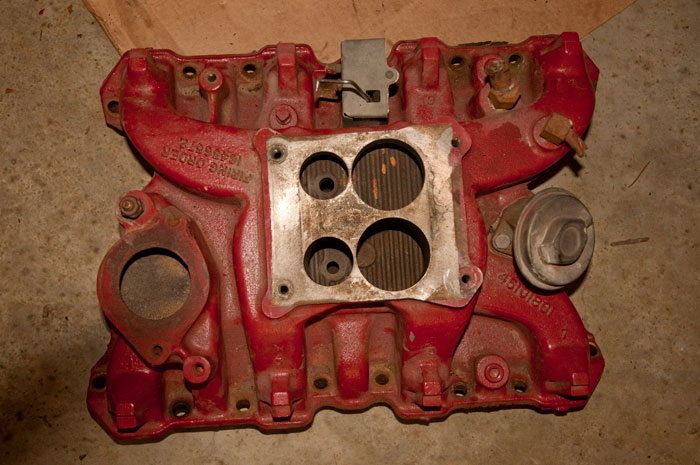
Let’s dive into a classic automotive mystery: the tale of two 4-barrel spreadbore intake manifolds—one with a perfectly flat top, and one with a strange, recessed valley right beneath the carburetor mounting flange.
The Clues: Flat Top vs. The Deep Cut
Take a look at a classic factory cast-iron intake manifold. If you flip through the part numbers cast into the runner for cylinder #7, you might notice two distinct versions:
-
- The C1 Suffix: A flat-top spreadbore manifold.
- The C2 Suffix: A later-generation manifold that features a distinct recess or undercut directly below where the carburetor sits.
If you are a novice builder, seeing that uneven, recessed surface under your carb for the first time can give you a serious case of anxiety. Is it broken? Is it machined wrong? Will it cause a massive vacuum leak?
The short answer is no. It was actually a brilliant, low-cost piece of factory engineering.
The Backstory: Taming the Carter ThermoQuad
Back in 1974, International introduced the massive Carter ThermoQuad carburetor to the 345 and 392 V8 lines. The ThermoQuad was an incredible fuel mixer, but it had a dramatic design feature: tiny primary throttle valves paired with absolutely massive secondary flaps.
When those secondaries kicked open, a giant, sudden dose of air and fuel rushed into the engine all at once. Because the secondary side didn’t have an accelerator pump to smooth out the transition, it caused an uneven fuel distribution. The engine would stumble, idle roughly, and worst of all for the mid-1970s—it failed tightening federal emissions standards.
International Harvester was on a tight budget and couldn’t afford to completely redesign a brand-new engine block or heavy casting mold. They needed a fix that cost pennies per engine.
The Fix: An “Air-Gap” Balance Tube Before Its Time
Their solution was beautiful in its simplicity: they altered the machining line to undercut the intake flange.
By cutting out that recess, they tied all four intake plenums together with a common crossover right at the very top. In the motorcycle and high-performance racing world, we call these balance tubes.
This small chamber acts as an open air space that instantly balances out the air-to-fuel ratio across all cylinders during idle and acceleration. It vastly improved idle quality, smoothed out the throttle response, and allowed the factory to lean out the fuel circuits to pass smog checks without changing the base engine blueprint.
In fact, this exact “medium-high rise” design with an “air gap” is the exact same layout used by major aftermarket performance brands today!
Quick Tech Tips for Swapping Your IH Manifold
If you are currently cleaning up an old cast-iron setup or dropping a replacement engine into your Scout II, keep these three rules in mind:
-
- Seal Your Threads: Many of the intake manifold bolts penetrate directly into the intake runners inside the cylinder heads. If you don’t coat the bolt threads with a quality thread sealant (like Hylomar or Permatex #2), your engine will draw a steady, hidden vacuum leak straight past the bolts! Do not use standard RTV silicone here.
- Ditch a Damaged EGR: Many used C2 manifolds come out of the donor truck with badly bent or frozen EGR valves. Because factory replacement EGR valves are nearly impossible to find today, your best bet for a non-emissions street build is to buy a simple aluminum EGR block-off plate to seal up the port.
- Watch the Weight: These original iron manifolds weigh a massive 53 pounds. Lift with your legs, or better yet, use a shop hoist when dropping it down onto your valley pan gasket so you don’t accidentally smear your sealant lines!